
Hard Mica Board vs Soft Mica Board: Characteristics and Application Scenarios
Published time:
2026-01-07 11:06
Source:


You may ask how Hard Mica Board is different from flexible mica sheets when picking insulation materials. Many projects need good heat and electrical insulation, but not all materials work for every job. Some jobs need strong and stiff boards, but others need bendy ones.
Choosing the right mica sheet can change safety, how well things work, and how long they last. Knowing these differences helps you pick what is best for your needs.
Key Takeaways
- Hard mica boards are very good at stopping electricity. They stay strong and steady, so people use them for high-voltage jobs.
- Flexible mica sheets can bend easily. They fit into small or odd spaces. They are great for wrapping pipes and uneven places.
- You should pick the right mica sheet for your project. Think about how hot it will get, how strong it needs to be, and how you will put it in.
- Always look at the quality and details of mica sheets before you buy them. This helps make sure they are safe and work well.
- Think about how thick the mica sheet is. Thicker sheets keep out electricity and are stronger. Thinner sheets can bend more easily.
Hard Mica Board (Rigid Mica Sheets): Overview
Structure and Composition
Hard mica board is special because of how it is made. Manufacturers make rigid mica sheets by stacking thin pieces of mica. They use strong glue, like epoxy or silicone resin, to hold the layers together. This glue keeps the mica in place and makes the board hard. The board does not bend much and stays in shape even when pressed.
Here is a table that lists what is inside hard mica board:
| Component | Percentage |
|---|---|
| Mica | 90% |
| Silicone Resin | 10% |
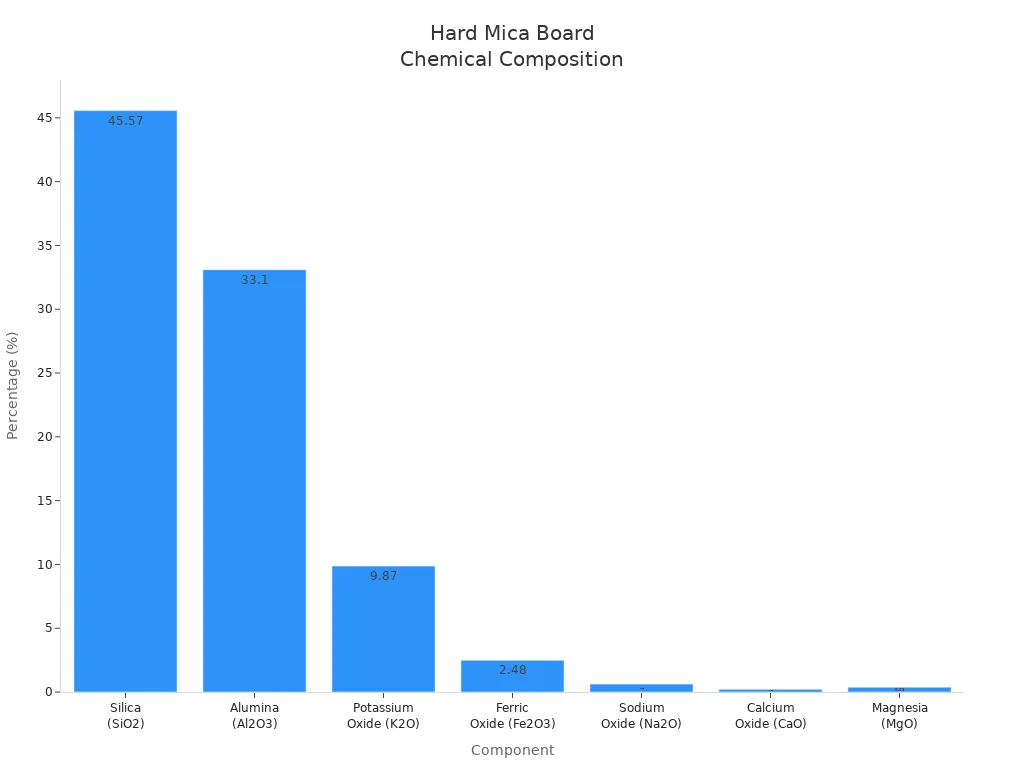
Most of the board is mica. This mineral helps rigid mica sheets resist heat and stay strong. Silicone resin sticks the layers together and makes the board tougher. You can also look at the chart below to see the chemical parts:
Key Properties and Strengths
If you pick hard mica board, you get great insulation and stability. Rigid mica sheets can block electricity, even at high voltages. Most hard mica boards have dielectric strength from 50 to 150 kV per millimeter. Some can even handle up to 2000 kV per millimeter before they break.
Rigid mica sheets keep their shape, even in high heat. This makes them good for electrical insulation in motors, transformers, and heating equipment. The table below shows how hard mica board compares to other materials:
| Material | Mechanical Stability Under High Temperature | Notes |
|---|---|---|
| Hard Mica Board | Superior | Maintains structure, does not deform easily |
| Kaolinite-Filled Rubber | Inferior | Can stretch or tear over time |
You can trust hard mica board for jobs that need strength and safety. Rigid mica sheets work well in tough places and protect equipment from heat and electricity.
Flexible Mica Sheets: Overview
Structure and Flexibility
Sometimes, insulation needs to bend and fit small spaces. Flexible mica sheets are good for this. Makers use thin mica paper and glue to make them. This makes the sheets soft and easy to move. You can bend or fold flexible mica sheets. They do not break when you shape them. This helps you put insulation on curved or odd surfaces.
Flexible mica sheets fit where hard boards cannot go. You can use them to wrap pipes or wind small motors. The table below shows how flexible mica sheets and hard mica boards are different:
| Property | Rigid Mica Sheets | Flexible Mica Sheets |
|---|---|---|
| Mechanical Strength | High, withstands significant stress | Lower, designed for flexibility |
| Dimensional Stability | Maintains shape under temperature changes | Less stable, conforms to surfaces |
| Density | Higher density due to compression | Typically thinner, less dense |
| Conformability | Rigid, not suitable for irregular shapes | Highly flexible, adapts to curves |
| Installation | Requires precise machining | Easier to install in tight spaces |
Flexible mica sheets bend around corners and curves. You do not need special tools to use them. This makes installation faster and easier.
Tip: Always check flexible mica sheets before you buy. Vendors use different glues and mica types. Good flexible mica sheets last longer and work better.
Electrical and Thermal Performance
- Flexible mica sheets give good insulation for heat and electricity. You can pick sheets from 0.10 to 2mm thick. There are two main grades: MF SSP (phlogopite mica) and MF SSM (muscovite mica). Each grade handles heat in its own way.
- Flexible mica sheets work in places with medium or high heat. Thicker sheets block heat better than thin ones. The mica type also matters. Muscovite mica resists heat more, but phlogopite mica works at higher temperatures with less insulation.
Flexible mica sheets are used when you need both bending and insulation. They help protect wires, cables, and heating parts. The table below shows how they compare for electrical insulation:
| Type | Electrical Insulation Properties |
|---|---|
| Hard Mica Board | Outstanding electrical insulation capabilities, ideal for electrical appliances and industrial use. |
| Flexible Mica Sheets | Varies by grade, typically used in applications requiring flexibility and moderate insulation. |
- Flexible mica sheets resist heat well in many jobs.
- Thin flexible mica sheets block less heat.
- You can choose the grade and thickness for your project.
- You should always check the vendor and product quality. Good flexible mica sheets from trusted sellers keep you safe and give steady results.
Key Differences Between Rigid and Flexible Mica Sheets
When you look at rigid mica sheets and flexible mica sheets, you notice they are not the same. They work in different ways and are used for different things. This part will help you see how they are different. We will look at their strength, insulation, how they handle heat, and how thickness changes what they can do.
Mechanical Strength vs. Flexibility
Think about strength and bending when picking mica sheets. Rigid mica sheets are very strong. They can hold heavy things and do not change shape when pressed. Flexible mica sheets bend easily and can go around corners, but they cannot hold as much weight.
Here is a table that shows how they are different:
| Property | Rigid Mica Sheets | Flexible Mica Sheets |
|---|---|---|
| Mechanical Strength | High, withstands significant stress | Lower, less capable under heavy loads |
| Dimensional Stability | Maintains shape under temperature changes | Less stable, may deform under stress |
| Density | Higher density due to compression | Thinner layers, lightweight |
| Applications | Structural support, mounting hardware | Vibration, thermal cycling, irregular surfaces |
- Rigid mica sheets are good for jobs that need strong support. You might use them to hold hardware or heavy parts. Flexible mica sheets are better for places that move a lot or have odd shapes.
- Rigid phlogopite sheets can be very strong, up to 230 N/mm².
- Their tensile strength is between 100 and 110 N/mm².
- If you want something that does not bend or break, pick rigid mica sheets. If you need something that bends and moves, flexible mica sheets are better.
Insulation and Temperature Resistance
Both types of mica sheets are good insulators, but they act differently in heat. Rigid mica sheets block electricity well and can take high voltages. Flexible mica sheets also insulate, but they are best in very hot places.
Here is a table that compares how they work with heat and electricity:
| Property | Hard Mica Board | Soft Mica Board |
|---|---|---|
| Heat loss at 500 °C (%) | ≤ 1.00 | ≤ 0.60 |
| Flexural Strength (kgf/mm²) | ≥ 18 | ≥ 16 |
| Dielectric Strength (KV/mm) | >20 | >18 |
| Insulation Resistance (MΩ) | 200-600 | 100-600 |
| Long Run Work Temperature | 500 °C | 800 °C |
Hard mica board is used for electrical insulation in motors and transformers. It works up to 500°C. Soft mica board, especially phlogopite, can work at even higher heat. Some flexible mica sheets can last at 800°C for a long time.
| Type of Mica | Continuous Service Temperature | Intermittent Service Temperature |
|---|---|---|
| Muscovite | Up to 500°C | Up to 800°C |
| Phlogopite | Up to 700°C | Up to 1,000°C |
If your project gets very hot, use flexible mica sheets made from phlogopite. For most electrical jobs, rigid mica sheets work well.
Thickness and Application Impact
- How thick the mica sheet is changes how it works. Rigid mica sheets come in many thicknesses, from 0.2mm to 50mm. Flexible mica sheets are thinner, from 0.10mm to 2mm. The thickness you pick changes how strong and how insulating the sheet is.
- Hard mica boards: 0.2mm to 50mm thick
- Soft mica boards: 0.10mm to 2mm thick
- Thicker sheets are stronger and insulate better. Thin sheets bend more and fit in small spaces. Here is a table that shows how thickness changes what you can do:
| Thickness Category | Characteristics | Application Scenarios |
|---|---|---|
| Thin (0.05mm to 0.5mm) | Good flexibility and elasticity | Bending or variable shapes, like cable insulation |
| Medium (0.5mm to 1.5mm) | Moderate flexibility | Versatile uses needing some rigidity |
| Thick (1.5mm or more) | High temperature resistance, less flexible | High temperature areas, electronic equipment insulation |
Pick the thickness that fits your project. Thin flexible mica sheets are best for wrapping wires or covering curves. Thick rigid mica sheets are better for holding heavy things or blocking lots of heat.
Note: Mica does not let heat pass through easily and is great at blocking electricity. This makes both types good for insulation and fire safety.
When you compare rigid and flexible mica sheets, you see each one is good for different jobs. Your choice depends on what your project needs, where it will be used, and if you need it to bend or stay strong.
Application Scenarios for Hard and Soft Mica Boards
Where Hard Mica Board Excels
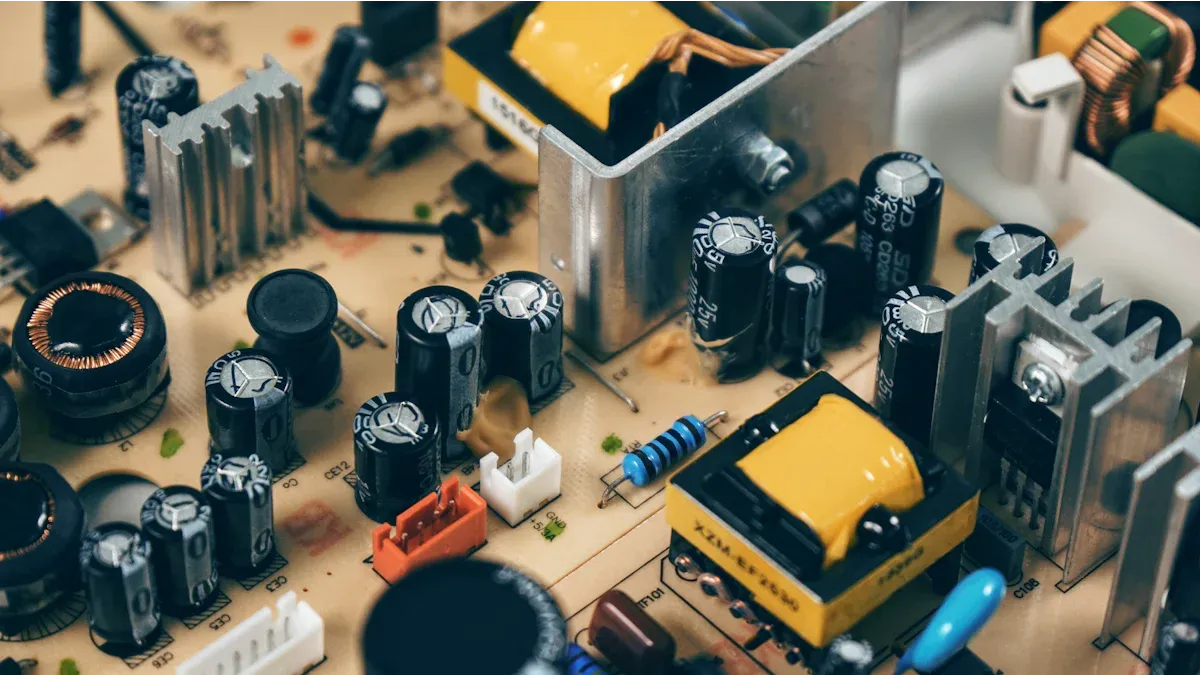
- Hard mica boards are used where strong insulation is needed. They work well in places with high heat. You see them in heavy industry and electrical machines. Some common uses are:
- Power electronics, like transistors and capacitors, need safety and good performance.
- Furnaces and kilns use mica because it does not break in heat.
- Rotating electric machines need insulation for long life.
- High-voltage equipment uses muscovite mica for strong dielectric strength.
- Chemical plants use mica because it does not get damaged by many chemicals.
- Hard mica boards help save space. Thin sheets block high voltages. This lets you make small and safe electrical systems. Mica does not burn, so it lowers fire risks.
| Type of Mica | Maximum Temperature (°C) |
|---|---|
| Muscovite | 500 |
| Phlogopite | 1000 |
Tip: Pick the mica type for your project’s temperature. Muscovite is good for most electrical jobs. Phlogopite works better for higher heat.
Where Flexible Mica Sheets Are Preferred
Flexible mica sheets are best for insulation on curved or moving parts. You can use them for:
- Power electronic devices to stop shorts and heat.
- Flexible heating elements in textiles, food, and medical devices.
- Ovens and microwaves use mica to keep heat inside.
- Microwave waveguide covers let microwaves pass but block food and dirt.
Flexible mica sheets are easy to install. You can wrap them around wires and pipes. Their light weight makes them simple to handle. They last a long time and do not age fast. Furnace linings last longer with flexible mica sheets, so you replace them less.
Note: Flexible mica sheets cover everything and lower heat loss. Use them where hard boards cannot fit.
Comparison Table: Typical Uses
| Application | Hard Mica Board | Flexible Mica Sheet |
|---|---|---|
| Electrical insulation | ✔️ | ✔️ |
| High-temperature furnaces | ✔️ | |
| Microwave oven covers | ✔️ | |
| Flexible heating elements | ✔️ | |
| Chemical resistance | ✔️ | |
| Wrapping wires/pipes | ✔️ |
Pick hard mica boards for strong support and high heat. Choose flexible mica sheets for easy use and curved surfaces.
Choosing the Right Mica Sheet
Factors to Consider
When you pick a mica sheet, you need to think about many things. Every project is different, so you must choose what fits best. Here are some things to look at:
- See if the mica sheet meets IEC 60252 and UL 1449 rules for insulation.
- Make sure it follows RoHS and REACH rules if you use it in the EU.
- Ask your supplier for ISO 9001:2015 and ISO 14001 papers to check quality.
- Look for a fire safety rating like UL 94 V-0.
- Test how well it blocks electricity. You want at least 10 kV/mm for most jobs.
- Make sure the mica sheet can handle heat up to 500°C or more.
- Check if it stays strong and keeps its shape when hot or pressed.
- Pick the right thickness. Thick sheets are stronger and insulate better. Thin sheets bend more.
- Think about where you will use it. If there is lots of heat, shaking, or pressure, you may need a thicker and tougher sheet.
Tip: Always ask your vendor for test reports and certificates before you buy.
Practical Selection Guide
You can use a simple guide to help you choose:
Write down what your project needs. List the highest temperature, voltage, and any stress.
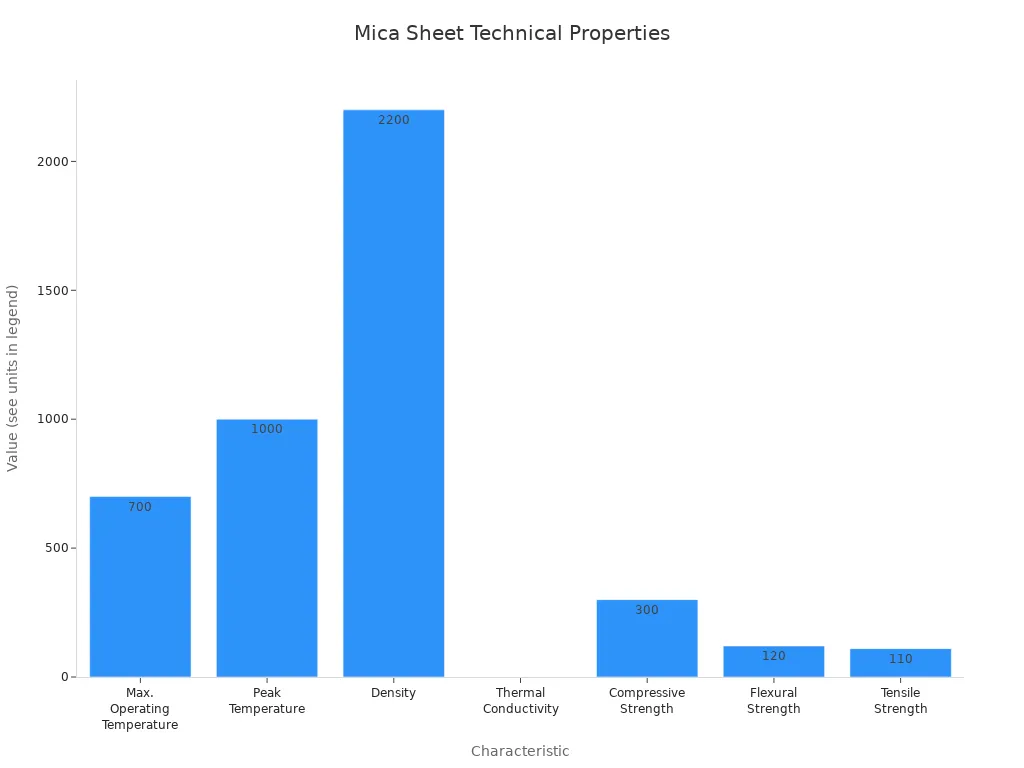
Match these needs with the mica sheet’s data. Use the table below to compare:
| Characteristic | Value |
|---|---|
| Max. Operating Temperature | 700 °C |
| Peak Temperature | 1,000 °C |
| Density | 2,200 kg/m³ |
| Thermal Conductivity | 0.30 W/m·K at 23 °C |
| Compressive Strength | 300 kJ/m² at 20 °C |
| Flexural Strength | 120 MPa |
| Tensile Strength | 110 MPa |
Pick the thickness that works for your job. Thicker sheets are better for high heat or stress.
Check the vendor’s quality. Use this table to help you:
| Criteria | Description |
|---|---|
| Competency | Good quality, trained workers, and a strong record. |
| Capacity | Can fill your order and deliver on time. |
| Commitment to Quality | Follows rules and checks products often. |
| Consistency of Performance | Gives you the same good product every time. |
| Cost | Offers fair prices for long-term buying. |
| Cash and Finance | Is stable with money. |
| Communication | Talks clearly and keeps you updated. |
| Control of Internal Processes | Handles stock and checks quality well. |
| Corporate Social Responsibility | Follows laws and cares for the environment. |
| Culture | Has values that help teamwork. |
If you follow these steps, you can feel sure about your choice. This way, you balance insulation, strength, and flexibility. You get good results every time.
- You can easily tell hard mica boards and flexible mica sheets apart. Hard mica boards are strong and help support things well. They also keep electricity from passing through. Flexible mica sheets can handle very high heat. Phlogopite mica can work up to 1200°C.
- Pick hard mica boards if you need things to stay in place.
- Use flexible mica sheets for round shapes or very hot spots.
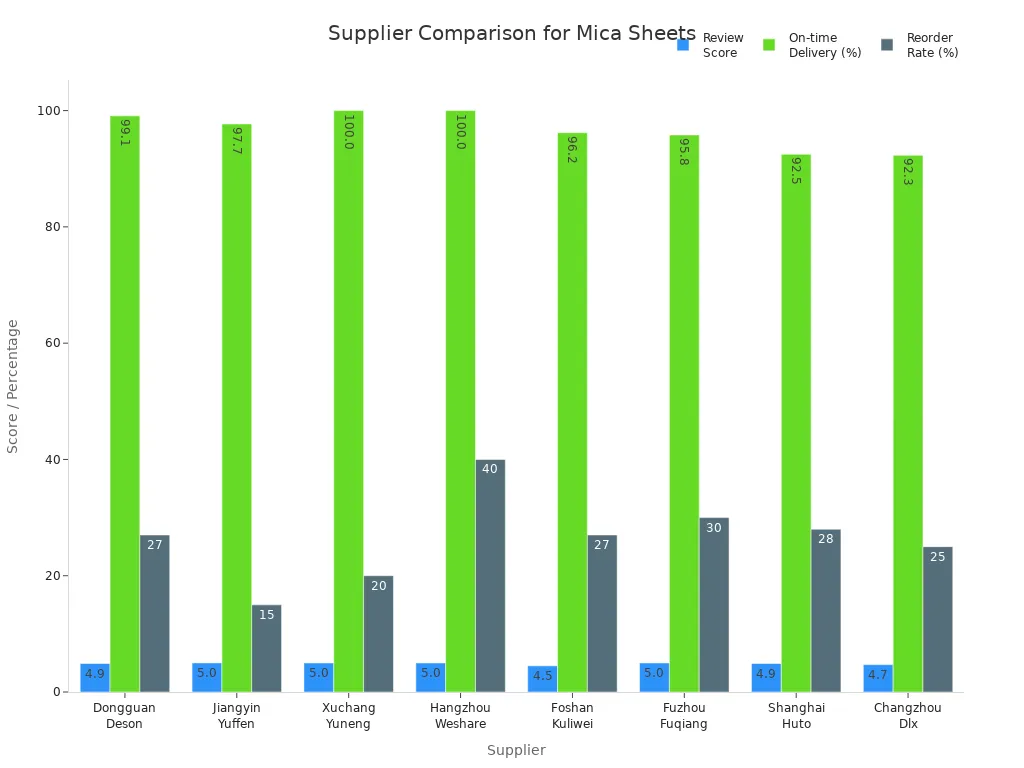
People sometimes make mistakes when choosing mica sheets. They may pick a grade that is too high or forget about the binder type. Always look at supplier ratings and reviews before buying:
| Supplier | Review Score | On-time Delivery |
|---|---|---|
| Dongguan Deson Insulated Materials Co., Ltd. | 4.9/5.0 | 99.1% |
| Hangzhou Weshare Import And Export Co., Ltd. | 5.0/5.0 | 100.0% |
Tip: Think about what your project needs. Talk to expert vendors to make sure you get good quality.
FAQ
What makes mica insulation different from other insulation materials?
Mica insulation can handle high heat and blocks electricity well. It does not get damaged by heat, chemicals, or electricity like other materials. You can use mica when you need strong protection from heat and electricity.
Can you use flexible mica sheets for high-temperature applications?
Flexible mica sheets work for jobs with high heat. They can handle temperatures up to 1000°C. People use them in ovens, furnaces, and heating parts because they stop heat from passing through.
How do you choose between hard and soft mica boards for your application requirements?
First, look at what your project needs. If you want something strong and good at blocking electricity, pick hard mica boards. If you need to cover curved shapes or places that move, flexible mica sheets are better. Always make sure the sheet matches your heat and electricity needs.
What are the pros and cons of flexible mica sheets?
Flexible mica sheets bend and fit into odd spaces. They block heat and electricity well. They cannot hold heavy things. You should check how thick and strong they are before using them.
Why does mica have high chemical resistance and dielectric properties?
Mica is made of layers. Chemicals cannot break these layers easily. Mica blocks electricity and heat because of its structure. This makes it great for insulation.
Related Blog
Related Downloads

Company Address: Wushi Industrial Park, Xingwang Road, Pingjiang High-tech Industrial Park, Wushi Town, Pingjiang County, Hunan Province


This website supports both IPv4 and IPv6 access.