
Muscovite vs. Biotite: A Comprehensive Guide to Their Properties and Uses
Published time:
2025-08-28 15:34
Source:


Introduction
Mica minerals are some of the most fascinating and widely studied silicate minerals in geology. Among them, muscovite and biotite are two of the most common and important representatives. Both belong to the phyllosilicate group, sharing a sheet-like structure with excellent basal cleavage, but they differ significantly in color, composition, and applications.
Understanding these minerals is essential not only for geologists but also for industries that rely on their unique thermal, electrical, and physical properties. In this article, we will explore the geological significance, physical and chemical characteristics, and industrial uses of muscovite and biotite.
Geological Significance of Muscovite and Biotite
Formation Processes
Muscovite and biotite form under different geological conditions:
Muscovite develops in aluminum-rich environments, particularly in granitic pegmatites and metamorphic schists.
Biotite forms in magnesium- and iron-rich conditions, common in igneous rocks like granite, diorite, and basalt.
Role in Rock Types
Igneous Rocks: Biotite is abundant in granite and diorite, while muscovite often appears in pegmatites.
Metamorphic Rocks: Both minerals are characteristic components of schist, phyllite, and gneiss. They serve as index minerals, helping geologists interpret metamorphic grade.
Sedimentary Rocks: Weathered mica fragments accumulate in sandstones and shales, contributing to clay mineral formation.
Together, muscovite and biotite play a crucial role in rock classification and provide insight into the pressure-temperature conditions of Earth’s crust.
Physical and Chemical Properties
Although muscovite and biotite share the sheet silicate structure, they differ in appearance, density, and chemical composition. Below is a comparison table in EAV (Entity–Attribute–Value) format:
| Entity | Attribute | Value |
|---|---|---|
| Muscovite | Color | Silvery, transparent, or light-colored |
| Muscovite | Cleavage | Perfect basal cleavage (thin elastic sheets) |
| Muscovite | Hardness | 2–2.5 on Mohs scale |
| Muscovite | Density | ~2.8 g/cm³ |
| Muscovite | Chemical Composition | KAl₂(AlSi₃O₁₀)(OH)₂ – rich in aluminum |
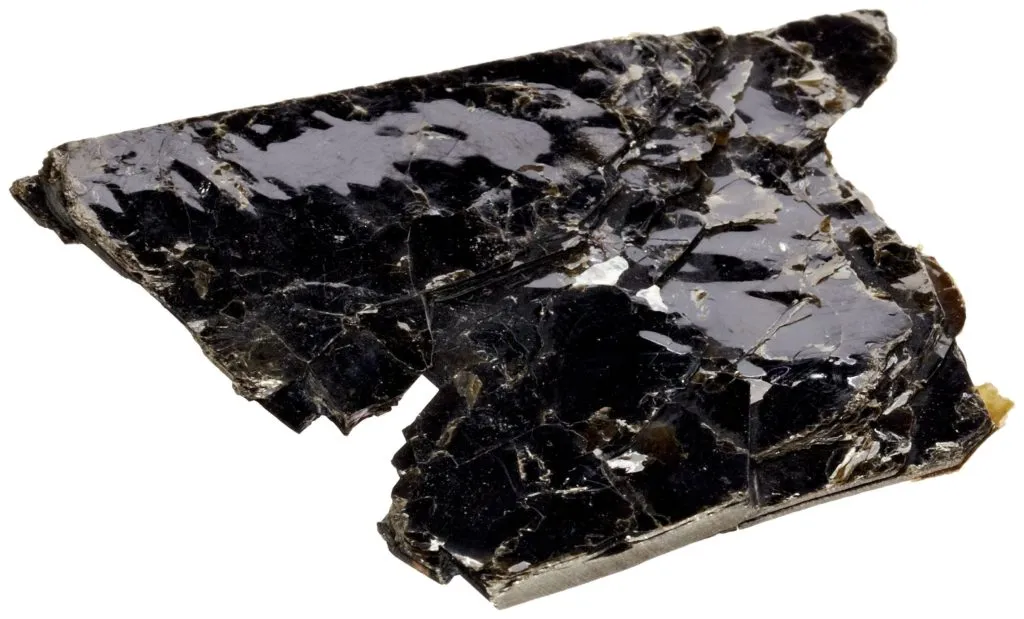
| Biotite | Color | Dark brown to black |
| Biotite | Cleavage | Perfect basal cleavage (thin flexible sheets, less elastic than muscovite) |
| Biotite | Hardness | 2.5–3 on Mohs scale |
| Biotite | Density | ~3.0–3.4 g/cm³ |
| Biotite | Chemical Composition | K(Mg,Fe)₃(AlSi₃O₁₀)(OH)₂ – rich in iron and magnesium |
Visual Identification
Muscovite: Light-colored, glassy sheets that are transparent to translucent.
Biotite: Darker, opaque sheets with a brownish-black appearance.
The contrast between their physical properties makes them easily distinguishable in hand samples and thin sections under a microscope.
Industrial and Commercial Applications
Electronics and Electrical Uses
Muscovite: Widely used as an electrical insulator due to its high dielectric strength and thermal stability. It is a vital component in capacitors, high-voltage equipment, and semiconductor manufacturing.
Biotite: Less commonly used in electronics but valuable in certain high-temperature insulation applications.
Cosmetics and Personal Care
Muscovite: Ground into fine powder and used as a shimmering agent in makeup products such as eyeshadow, highlighter, and foundation. It provides natural luster and transparency.
Biotite: Occasionally used as a pigment in mineral-based cosmetics, giving darker shades.
Other Industrial Uses
Muscovite sheets were historically used as “isinglass windows” in stoves and lanterns due to their heat resistance.
Biotite, though less commercially important, is utilized in ceramics and construction materials as a filler.
Conclusion
Muscovite and biotite, though closely related as members of the mica group, differ in appearance, chemistry, and applications. Geologically, they are valuable indicators of rock formation processes and metamorphic conditions. Industrially, muscovite plays a dominant role in electronics and cosmetics, while biotite has niche applications.
Next Page
Related Blog
Related Downloads

Company Address: Wushi Industrial Park, Xingwang Road, Pingjiang High-tech Industrial Park, Wushi Town, Pingjiang County, Hunan Province


This website supports both IPv4 and IPv6 access.