
Mica price trends 2025
Published time:
2026-01-27 10:08
Source:


You can expect mica price trends in 2025 to show a steady increase. The projected market value for mica will reach $2,056.5 million, with a 5.4% annual growth rate.
These trends matter because several factors affect mica price:
- Mining and raw material costs from regions like Pakistan and India can change.
- Supply chain issues and trade policies may impact availability.
- Processing expenses and rising demand in electronics and cosmetics drive prices higher.
Understanding these factors helps you make better choices in buying and planning.
Key Takeaways
- Mica prices are expected to rise steadily in 2025, reaching a market value of $2,056.5 million with a 5.4% annual growth rate.
- Key factors influencing mica prices include mining costs, supply chain issues, and rising demand in electronics and cosmetics.
- To manage costs effectively, buyers should monitor market trends and consider multiple sourcing strategies.
- Sustainability and ethical sourcing are becoming increasingly important, impacting both costs and brand reputation.
- Understanding regional price variations can help businesses find the best sourcing options and adapt to market changes.
Mica price outlook
2025 price direction
You will likely see mica price continue to rise in 2025. Industry experts expect the global market value to reach between $547.3 million and $598.7 million. The annual growth rate should stay between 3.2% and 4.3%. This steady increase comes from several important factors that shape the market.
You can see that mining costs and trade policies play a big role. Processing expenses and strong demand from electronics and automotive industries also push prices higher. Changes in exchange rates and inflation in mining regions add more pressure.
Industry analysts predict steady growth for mica price in 2025. The market should expand from $684.44 million in 2025 to $724.31 million in 2026. This means a compound annual growth rate of 5.49%. You can expect a positive trend in both pricing and market value.
📈 Tip: If you plan to buy or use mica, keep an eye on these factors. They can help you make better decisions and manage your costs.
Comparison with previous years
You may notice that mica price trends have shifted over the past few years. In 2023, the average price dropped to $0.85K per ton, showing a decrease of 6.22%. In 2024, the price stayed around $0.8K per ton. However, the first half of 2025 shows a rebound, with the average price rising to $0.82K per ton and a growth rate of 17.14%. The last twelve months (from August 2024 to July 2025) show an even higher growth rate of 18.39%.
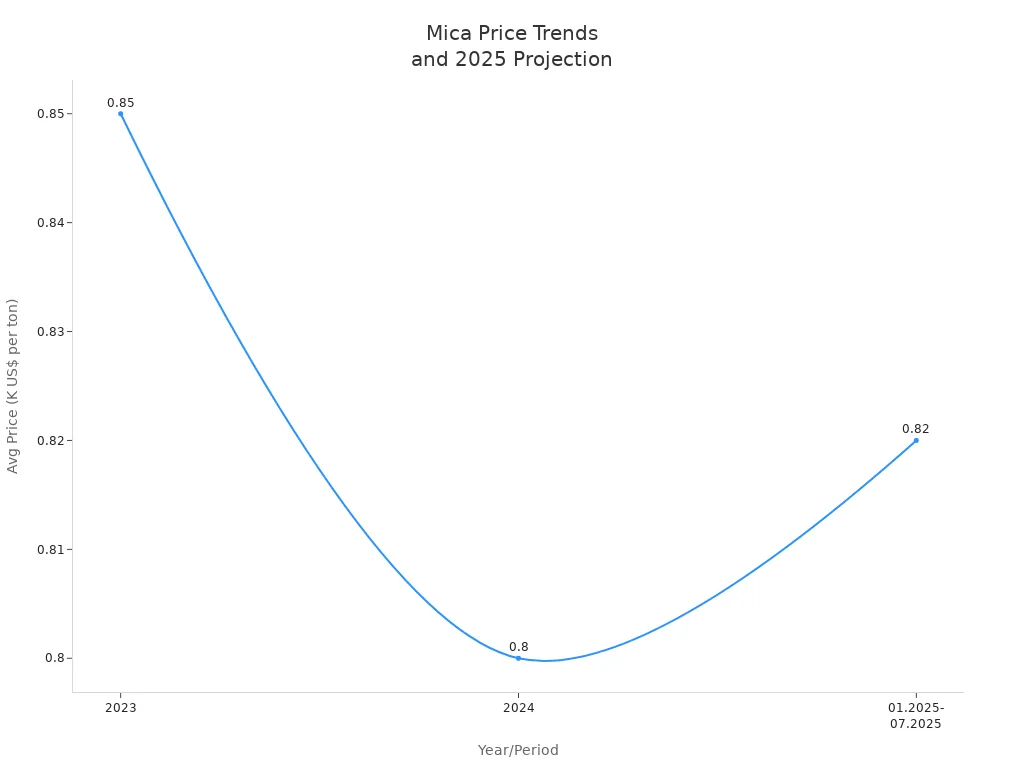
You can see from the chart that prices fell in 2023, stayed flat in 2024, and then started to climb again in 2025. This upward trend matches the growing demand and higher costs in the industry. If you follow these trends, you can better plan your purchases and avoid sudden price jumps.
Influencing factors

Mining and processing costs
You need to understand how mining and processing costs shape mica price in 2025. Mining companies face several types of expenses. These include daily operations, building new mines, and keeping equipment up to date. The table below shows the main cost components:
Key cost drivers that impact mica price include:
- Operating expenditures (opex)
- Capital expenditures (capex)
- Sustaining costs
- Regulatory changes
- A shift toward sustainable sourcing
When mining costs rise, you often see higher prices in the market. New technology in processing also changes costs. For example, better machines can make thinner and more reliable mica sheets. This helps meet the needs of electronics and automotive industries.
Supply chain and trade
Supply chain and trade changes play a big role in mica price trends. You may notice that imports of crude mica sheets to Germany have jumped by over 150% in value during the last six months of 2025. The average monthly growth rate for imports is 11.25%. This strong demand pushes prices higher. The average import price has also gone up by 11.03%.
Several factors shape these changes:
- Digital platforms make buying and selling mica faster and more transparent.
- New tariffs, such as those from the U.S., add extra costs to imports.
- E-commerce changes how mica moves from mines to buyers, making logistics more flexible.
You should watch for new trade policies and supply chain updates. These can quickly change the cost and availability of mica.
Global demand
Global demand for mica keeps rising in 2025. You see more mica used in construction, electronics, and cosmetics. The construction sector uses mica in plasters and coatings. Automotive coatings now use 19% more mica than three years ago. This is because mica makes materials lighter and more resistant to sunlight.
The mica powder market is set to grow from $380 million in 2025 to over $620 million by 2032. This shows a strong increase in demand. The compound annual growth rate is about 6.3%. Key drivers include:
- More electric vehicles need mica for battery insulation.
- The beauty industry wants ethically sourced mica.
- Construction projects use mica in many products.
When demand grows, you often see mica price go up. You should keep an eye on these trends to plan your purchases and manage your costs.
Market data and forecasts

Recent price movements
You can see several changes in mica prices from 2023 to early 2025. Here are some important points:
- In early 2025, Japan saw mica waste import prices rise by 3.03% compared to the previous year.
- The average price for mica waste imports reached about $340 per ton from January to August 2025.
- Japan’s mica waste imports increased by 15.39% in value and 11.81% in volume, showing a rebound in demand.
- Muscovite mica substrate prices went up by 3-7%, now ranging from $850 to $1,500 in early 2025. Higher logistics costs and strong demand in optical and electrical uses caused this increase.
These changes show that mica price trends are moving upward in many markets.
2025 forecast analysis
You should know that market research points to steady growth for mica through 2029. For example, China imported about 6 million kilograms of mica powder in 2023. This number is expected to reach over 6.6 million kilograms by 2028. The compound annual growth rate (CAGR) for mica imports is about 1.8% from 2024 to 2029.
Several factors drive this growth:
- Global market analysis and forecasts
- Sustainability rules for supply chains
- Sourcing strategies that affect cost and compliance
- Regional changes and new compliance documents
- More focus on supplier transparency in North America and Europe
- Advances in particle size engineering, which expand mica’s uses
- The need for better risk management in operations
You can use these insights to plan your purchases and manage your supply chain.
Regional variations
Mica price varies by region. The table below shows average import and export prices in major markets for 2025:
You may notice that the United States pays the highest import price. India and China have lower export prices. These differences come from local mining costs, trade policies, and demand in each region.
📊 Tip: Track regional price changes to find the best sourcing options for your business.
Price breakdown
Mica price by product type
You will find that mica comes in many types, each with its own price range. The type of mica you choose can affect your costs. Here is a table showing the 2025 price ranges for different mica types:
The price depends on the quality, size, and use of the mica. Muscovite and phlogopite often cost more because you can use them in electronics and high-end products. Biotite and lepidolite are more common in construction and other industries.
You should also know that natural and synthetic mica have different uses and prices. Natural mica powder is popular for its organic look and is often used in products that focus on sustainability. Synthetic mica powder is gaining ground because it offers bright colors and comes from ethical sources. Many cosmetic brands now prefer synthetic mica for its purity and safety.
💡 Note: Natural mica still holds a large share of the market, especially for brands that want natural ingredients. However, synthetic mica is growing in popularity, especially in premium cosmetics.
Raw ore, sheets, and powder
You can buy mica in several forms: raw ore, processed sheets, and powder. Each form has its own price range in 2025:
- Raw mica ore: $100–$400 per ton
- Processed mica sheets: $20–$200 per kilogram
- Mica powder: $10–$50 per pound
Industrial grades of mica are used in construction, paints, and plastics. These grades usually cost less than cosmetic grades, which must meet strict purity and safety standards. Cosmetic mica, especially synthetic, often costs more because it is free from heavy metals and other impurities.
The final mica price also depends on factors like raw material availability, manufacturing costs, global demand, and shipping rules. If you want to control your costs, you should watch these factors closely.
Business impact
Purchasing strategies
You need strong purchasing strategies to manage mica price changes in 2025. Prices keep rising, and this affects your costs and profits. Many companies now use several smart methods to control spending and reduce risks. The table below shows some of the most effective strategies you can use:
💡 Tip: Using more than one strategy helps you stay flexible and ready for sudden changes in the market.
Risk management
You face new risks as mica prices rise and rules change. Manufacturers in electronics and cosmetics see their profit margins shrink when mica costs go up. You can protect your business by planning ahead and making smart choices.
Many companies now look for new suppliers and test other materials. Some move production closer to home to avoid high import taxes. Others keep more inventory or use scenario planning to prepare for different price changes. These steps help you balance costs and keep your supply chain strong.
Environmental and ethical sourcing also matter more in 2025. You should choose suppliers who follow safe and fair mining practices. This not only helps the planet but also makes your brand stronger. Customers want products made with care for people and the environment. By focusing on responsible sourcing, you can meet new rules and build trust with buyers.
📈 Note: Companies that invest in sustainable sourcing and clear supply chains often see better market acceptance and stronger brands.
You will see mica prices rise in 2025 because of strong demand in electronics, construction, and cosmetics. Companies now focus on sustainability, supplier transparency, and choosing between natural and synthetic mica.
- The mica market grows as industries seek better insulation and durability.
- Synthetic mica gains popularity as a sustainable choice.
- Regulations push you to invest in certified sources.
Stay updated with trusted market reports and monitor supply chain changes. This helps you adapt your strategy and manage costs as the market evolves.
FAQ
What drives mica prices up in 2025?
You see higher mica prices because demand grows in electronics and cosmetics. Mining and processing costs also rise. Trade policies and supply chain issues add more pressure.
How can you reduce your mica sourcing costs?
You can lower costs by working with multiple suppliers, buying in bulk, and exploring alternative materials. Near-sourcing and keeping safety stock also help you manage price changes.
Is synthetic mica better than natural mica?
Synthetic mica offers better purity and color. Many cosmetic brands prefer it for safety. Natural mica remains popular for its organic look and lower cost.
Why do mica prices differ by region?
Prices change by region due to mining costs, local demand, and trade rules. For example, the United States pays more for imports than India or China.
Related Blog
Related Downloads

Company Address: Wushi Industrial Park, Xingwang Road, Pingjiang High-tech Industrial Park, Wushi Town, Pingjiang County, Hunan Province


This website supports both IPv4 and IPv6 access.