
Exploring the Industrial Value of Mica Material in Modern Markets
Published time:
2025-09-29 08:56
Source:


The industrial value of mica material in 2025 will be USD 596.6 million. Mica works very well in modern industries because it has special features.
Recent market data shows mica exports were the highest ever in 2024. Prices changed in different ways. Import prices dropped to $430 per ton. These facts show that more people want mica and the market is changing.
Key Takeaways
- Mica has special features. It can handle high voltage. It stays strong in heat. These features help many industries. Electronics, cars, and building companies use mica a lot.
- The mica market will grow fast. It may be worth USD 596.6 million by 2025. Many businesses want mica for different uses.
- Companies can make products better with mica. Mica helps with insulation and fire safety. It also makes things last longer. This makes products safer and work better.
- Getting mica in a good way is important. Mining should be safe and fair. This helps people trust the products. Customers want safe items.
- Learning about new trends is helpful. Knowing about new technology helps businesses change. This helps them do well in the mica market.
Mica Material Value
Industrial Significance
Mica is important in many industries because it has special features. Companies use mica to make things safer and work better. In cars, mica is in brake linings and exhaust gaskets. These parts help stop cars from getting too hot. This makes cars more reliable. Electronics makers use mica to stop electrical shorts and overheating. This keeps devices safe when they use high voltage. Builders like mica because it does not burn easily. It helps protect buildings from fire. Makers of electric vehicles use mica in battery insulation and cooling. This helps batteries last longer and work better. It also keeps electric powertrains safe. In foundries and steel plants, mica coats molds and acts as an insulator. This saves energy and makes metal products better.
- In cars, mica helps brakes and gaskets work well. It stops overheating and makes cars safer.
- In electronics, mica keeps devices from shorting out. It helps them work safely with high voltage.
- Builders use mica to make buildings safer from fire.
- Electric vehicles need mica for battery insulation and cooling. This helps batteries last longer and keeps them safe.
- In foundries and steel plants, mica coats molds and insulates. This saves energy and makes better metal products.
The table below shows how different industries use mica and how this changes market demand:
Key Properties
Mica is special because it has many useful properties. These make it a good choice for many jobs. Mica has a dielectric strength between 10 and 25 kV/mm. This stops electrical discharges and keeps equipment safe. Mica blocks electricity and protects devices from faults. Mica sheets are light and can bend easily. They can also handle very high heat, so they work in many places.
- Mica can handle high heat and does not expand much. This makes it great for electrical insulation.
- It does not burn and has strong dielectric properties. This makes it good for high voltage insulation.
- Mica sheets and rolls are used for furnace insulation and car gaskets. They work well even when it is very hot.
- Muscovite mica is known for its strong dielectric strength. It is used in electrical jobs.
- Mica melts at about 1200–1300 °C, so it is very stable in heat.
- It resists tracking and corona, so it is good for high voltage insulation.
Premium mica works even better in tough places. These types help companies meet strict safety and quality rules. Mica is still very important in new technology and making things today.
Mica Market Drivers
Supply Chain
The mica supply chain begins at the mines. Workers dig mica out of the ground. After mining, companies sort and clean the mica. Many countries are part of the mica trade. India, China, and Madagascar send out the most mica. These countries ship mica to factories worldwide. Good supply chains help meet what industries need. When supply chains run smoothly, orders get filled on time. Problems like export bans or shipping delays can cause shortages. Shortages can make prices go up and demand go down. Companies often search for new suppliers to follow new trade rules. Strong supply chains help the mica market grow steadily.
Technology
Technology changes the mica industry in many ways. New machines make processing faster and safer. Companies use better tools to sort and clean mica. These changes make products safer and better. Many businesses now make new mica products for customers. They focus on natural and earth-friendly choices. More companies compete by making better products. Some companies work together or join to get new technology. Online selling and digital ads help companies find more buyers, especially in cosmetics.
- New technology makes mica products safer and better.
- Companies create new products to match what people want.
- More competition means companies try to make better products.
- Companies team up or merge to get new technology and grow.
- Online selling and digital ads change how companies compete in cosmetics.
Regulations
Rules are very important in the mica market. Governments make laws to keep mining safe and fair. Some countries do not allow child labor in mica mines. These laws protect workers and help mica look better to buyers. Trade laws also change how mica moves between countries. Tariffs and export limits can change how much mica is traded. Companies must follow safety and environmental rules when working with mica. These rules can make costs higher but also build trust in mica. Clear rules help the market grow by making mica safer for everyone.
Mica Applications

Electronics
Mica is very important in electronics. Makers use mica sheets to keep electrical parts safe. This stops short circuits and lowers fire danger. Phlogopite mica can handle heat over 1000℃. Muscovite mica can take up to 500℃. These features keep devices from getting too hot. Mica helps control heat in electronics. Its layers let some heat move but still insulate. Companies use mica to spread heat in hot places.
Automotive
Car makers need mica for many uses. Mica keeps parts near engines and exhausts strong. It gives great electrical insulation, stopping leaks and shorts. Mica is tough, so thin sheets can take a lot of stress. It also slows down fire, making cars safer for people.
Construction
Mica makes building materials better in many ways. Builders put mica in paints, coatings, and concrete to make them last longer. Mica lowers heat flow, so buildings do not crack as much. It helps protect buildings from bad weather. Mica’s heat resistance is important for fire safety.
- Mica helps building materials last longer and stand up to weather.
- It is added to paints, coatings, and concrete to make buildings stronger.
- Mica’s heat resistance is key for fireproofing and keeping people safe.
Cosmetics
Cosmetic companies use mica for its shine and texture. Mica powder makes makeup look bright and pretty. It is in eyeshadow, highlighter, and lip gloss to make them sparkle. Over 70% of fancy brands like L’Oréal and Estée Lauder use mica to make products look better.
Mica powder is a key part of makeup. It adds shimmer, color, and texture to many products. It is used in foundations and powders to give a smooth look and reflect light for a glowing face.
- Mica is in foundations and powders for a smooth, matte look.
- It is mixed into highlighters to give a glowing shine.
- Mica is used in body shimmers and bronzers to make skin look nice.
Mica is still important in many new uses. Its special features make it needed in electronics, cars, buildings, and makeup.
Mica Prices in 2025
Natural Sheet Mica
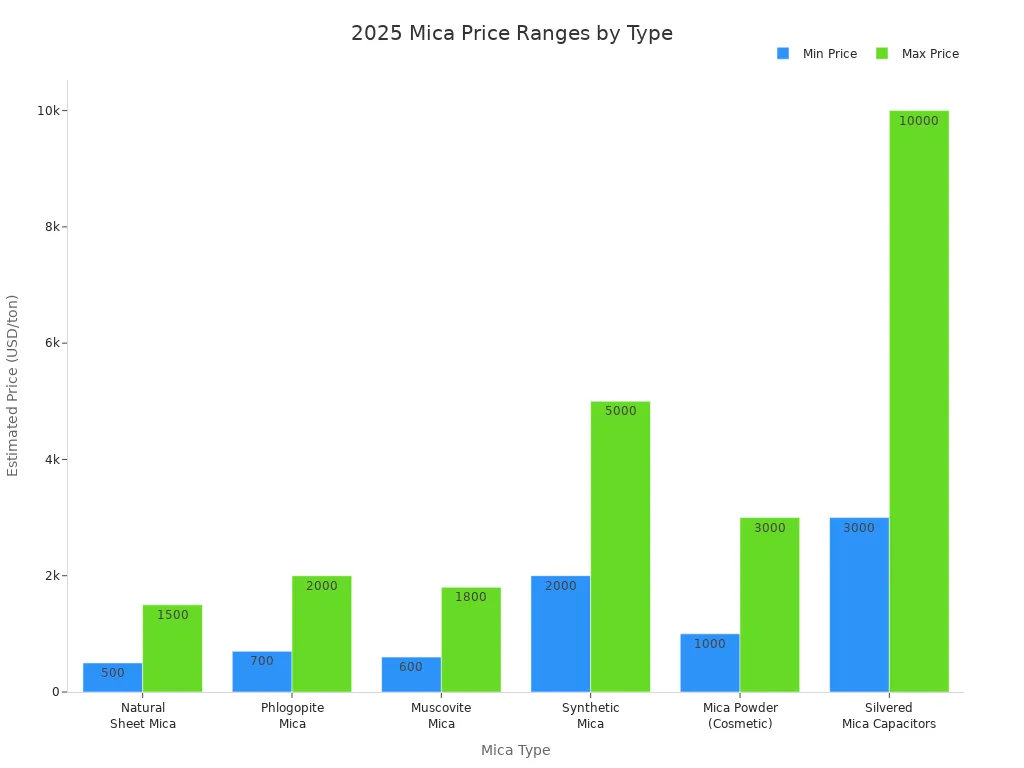
Natural sheet mica is still very important in the world market. In 2025, its price will be between $500 and $1,500 per ton. The price changes because of quality, size, and where it comes from. The table below shows prices for different types of mica:
Many things change mica prices in 2025. Mining and raw materials cost a lot. Labor and how mica is taken out also matter. Problems with shipping or export bans can make prices go up. Processing and making mica uses energy and workers, which adds to the cost. Electronics and cosmetics need a lot of mica, so prices stay high. Changes in money value and inflation can make prices go up and down. All these things make mica prices hard to guess.
Note: Political problems in mining areas can quickly change mica prices. Export bans or fights can cause shortages and make prices rise.
Phlogopite Mica
Phlogopite mica is used when things need to handle high heat. In 2025, phlogopite mica will cost between $700 and $2,000 per ton. The price depends on how good it is, how it is made, and where it comes from. The table shows phlogopite costs more than natural sheet mica because it can take more heat.
Many things change the price of phlogopite mica. More people want it for electronics and cars, so prices go up. Cosmetics and building companies also use more mica, which raises demand. Rules about trade, like tariffs and export limits, can change prices. Big sellers like China, India, and Africa affect how much mica costs. Sorting and cleaning mica adds to the price. Energy and worker pay also matter. If money values change or inflation goes up, prices can rise.
Supply chain problems, like wars or sickness, can make mica prices go up in 2025. These problems make it harder for companies to get enough mica.
Mica Powder
Mica powder is used a lot in makeup, paints, coatings, and electronics. In 2025, the mica powder market will be worth $1.3 billion to $1.5 billion. This is because more people want it in many industries. The biggest users are cosmetics, paints, and electronics.
- The mica powder market will grow by 5.8% each year from 2024 to 2032.
- More beauty products, paints, and electronics make the market bigger.
Mica powder prices in 2025 depend on how pure it is. Cosmetic-grade mica powder costs $1,000 to $3,000 per ton. Industrial-grade powder is cheaper. Prices change because of raw material supply, processing costs, and demand. Fights or export bans can make prices jump. Problems in the supply chain also make costs and delays worse.
Tip: Companies should watch mica prices and plan for supply problems. This helps them control costs and keep up with changes.
Mica prices in 2025 will likely stay high because demand is strong and supply is not always steady. Prices will keep changing as new things happen in the market.
Market Trends
Growth Rate
The mica industry keeps getting bigger every year. In 2024, the global mica market was worth USD 654.92 million. Experts think the market will grow by about 3.91% each year from 2025 to 2032. By 2032, the market could be almost USD 890.12 million. This steady growth means more companies want mica for their products.
- In 2025, the global mica market will be between USD 547.3 million and USD 598.7 million.
- The market is bigger than it was before.
- The yearly growth rate from 2025 to 2032 is about 3.2% to 4.3%.
Demand Shifts
Many industries use mica because it has special features. Electronics companies put mica in more devices since it handles heat and electricity well. The cosmetics industry uses mica because people want makeup with safe and natural ingredients. Builders add mica to construction materials for fire safety and insulation. These changes help the mica market get bigger.
- Electronics need more mica as technology gets better.
- Cosmetics companies pick mica for natural beauty products.
- Construction uses mica to make buildings safer and stronger.
Mica flakes and powder are growing fast in the market. In 2024, electronics used mica worth USD 250 million. By 2035, this could be USD 380 million. This shows that new technology needs more mica.
Innovation
Companies keep finding new ways to use mica. They work to make mica products safer and better for the planet. Many brands now get mica from places that protect workers and nature. Research teams make new kinds of mica for electronics, cosmetics, and building materials.
Companies that make new mica products and use safe practices will lead the market. These changes help the mica market grow and meet new needs.
Future Outlook
Forecasts
The mica market will keep getting bigger in the next ten years. By 2035, experts think it will be worth $870.7 million. This means the market will grow by 3.8% each year from 2025 to 2035. The total amount of mica could reach 440,000 tons by 2035. This is a yearly growth rate of 1.8%. The mica paper part will grow the fastest, with a 9.3% yearly rate. Other parts, like mica capacitors and mica sheet insulation, will also get bigger each year. Aerospace, automotive, and electronics companies will need more mica. Smaller devices and saving energy will make mica even more important.
- In 2035, the market will be worth $870.7 million.
- In 2035, the market will have 440,000 tons of mica.
- Mica paper will grow by 9.3% each year.
- Mica capacitors will grow by 5.2% each year.
- Mica sheet insulation will grow by 3.9% each year.
Opportunities
There are many new chances in the mica industry. Electronics and car companies need more mica for insulators and semiconductors. Builders and paint makers use mica because it is strong and looks nice. More people want earth-friendly materials, so natural mica is popular. Makeup companies like mica because it is safe and shiny. Flexible electronics and strong car parts use mica for its heat strength. Companies are finding new ways to process mica and make fake mica. Selling in new countries will help the mica industry grow more.
Tip: Companies can do well by using safe sources and making new mica products for growing markets.
Challenges
The mica market has some big problems. A lot of mica comes from illegal mines in India, where kids work. This problem is in the news and worries buyers. It is hard to know where mica comes from because many people are in the supply chain. Companies must make sure they get mica the right way and follow rules. People also worry about the environment and safe mining. Fixing these problems will help people trust mica and help the market grow for a long time.
Mica is valuable in 2025 because it handles heat, electricity, and pressure well. Many industries use mica insulation in wires, machines, and cars to make them safer and work better. Companies can do more by finding new suppliers, making synthetic mica, and tracking where mica comes from with better systems.
Knowing about different market groups and new technology helps companies keep up with changes.
Mica will become more important for clean energy and space travel as more people need good thermal insulation around the world.
FAQ
What makes mica valuable in modern industries?
Mica can handle heat, electricity, and chemicals very well. These features let companies use mica in many products. It is found in electronics, cars, buildings, and makeup. Mica helps keep devices safe and makes things last longer.
Is mica safe for use in cosmetics?
Most mica used in makeup is safe. Companies check mica for harmful metals and dirt. Good brands use mica that follows safety rules. Always look at the label to see if it is safe.
Where does most mica come from?
Most mica comes from India, China, and Madagascar. These countries send mica to factories all over the world. Companies pick suppliers by looking at quality and fair mining.
How do companies ensure mica is ethically sourced?
Many companies follow rules to stop child labor and unsafe work. They buy mica from trusted suppliers and join groups that check where mica comes from. This helps buyers trust the products.
What trends will shape the mica market in the future?
More people want mica for electronics, electric cars, and green products. Companies will look for safe ways to get mica and find new uses in technology.
Previous Page
Related Blog
Related Downloads

Company Address: Wushi Industrial Park, Xingwang Road, Pingjiang High-tech Industrial Park, Wushi Town, Pingjiang County, Hunan Province


This website supports both IPv4 and IPv6 access.